
Where Katy Directories Are Held
For Katy family history, no dedicated Katy city-directory run has been verified. The strongest dated lead is the University of Texas collection of the Richmond Telephone Directory, a regional series that includes Katy along with Richmond, Rosenberg, Fulshear, Sugar Land, and other nearby places. Its coverage should remain labeled as regional telephone-directory coverage. The Texas State Library and Archives Commission, local libraries, digital collections, and Harris County Archives add different kinds of historical context.
| Collections | Years | Where Held | Access |
|---|---|---|---|
| Richmond Telephone Directory, regional Katy-area coverage | Listed issue groups, 1918-2005, with gaps | UT Texas Directories collection | Holdings index and item-access route |
| TSLAC historical directories for Katy | Publisher and year vary; no Katy title verified | Texas State Library and Archives Commission Reading Room | On-site research |
| HCPL Katy Branch digital collection | Since 1921 | HCPL Digital Archive | Online collection search; item coverage varies |
| Harris County Archives Katy materials | Photographs 1922-1955; town file 1926-1973; branch materials 1954-1984 | Harris County Archives | Finding-aid and archive-request route |
For Katy research, directory years are not continuous. The UT listing preserves selected issue groups rather than proving a complete annual run, and no fully digitized Katy directory has been confirmed. Keep a list of absent years. A household can also be omitted because the volume, spelling, telephone listing, or service area changed. Katy researchers should preserve the collection, issue, and county context together.
Katy Directory Access Routes
The UT Texas Directories Index is a holdings tool, not a universal full-text people search. Katy researchers can narrow by location wording, directory type, optional year range, and browse controls. A result can point to a telephone white or yellow section, a residential listing, a commercial listing, a historical directory, or another format. Record the exact title and issue date before drawing a conclusion from a listing. Katy readers should retain the catalog's exact location wording.
The TSLAC city-directory guide identifies its Austin Reading Room as an on-site channel. Staff do not conduct phone searches, create transcriptions, or send email scans for a person entry. For a Katy volume, catalog leads at UT, UNT, WorldCat, the Library of Congress, and participating library databases can help identify a volume before an in-person visit.
TSLAC's directory-research guidance sets out the on-site route for Katy city directory work.
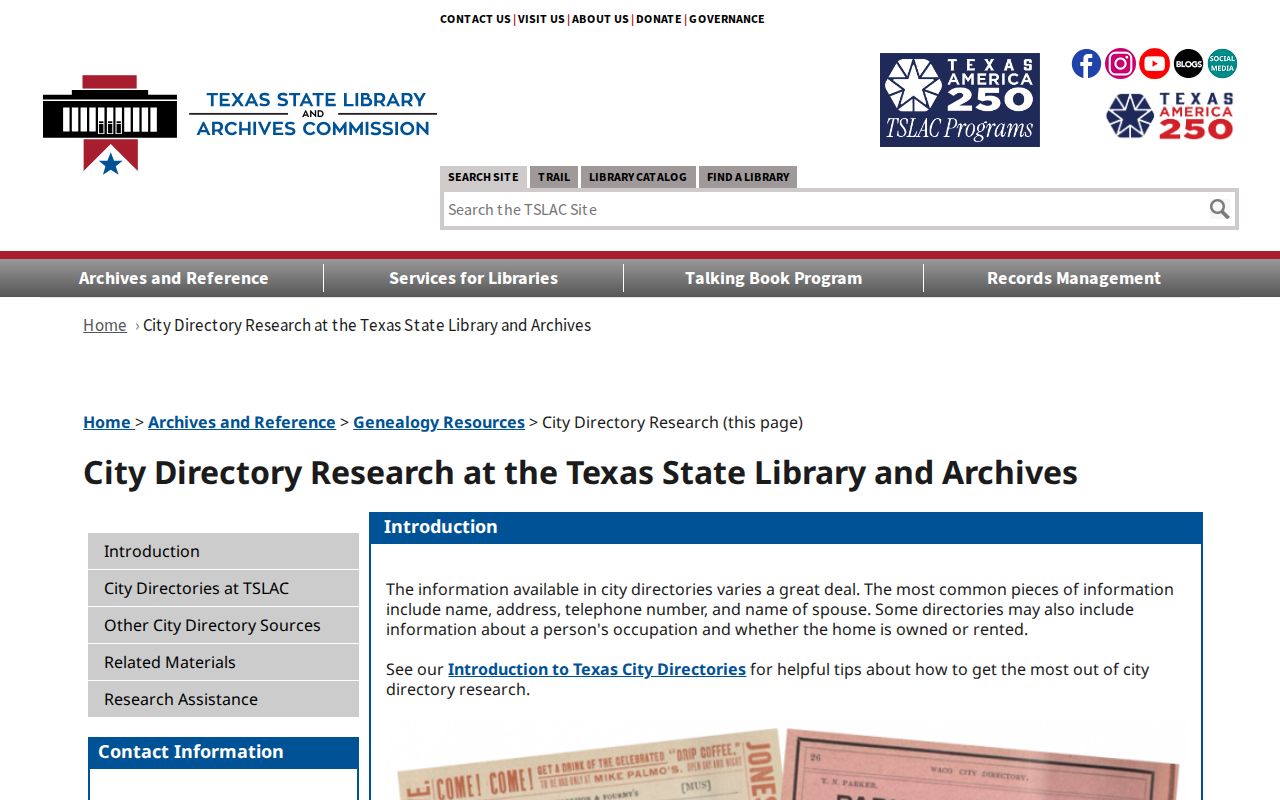
For a Katy historical directory question, the image is a reminder that a catalog hit and a remote transcription are different services. Plan for the Reading Room when the physical volume is the needed source.
Note: A Katy name in a catalog is a lead, not proof that the volume contains a particular Katy household.
Katy Telephone Directory Coverage
The UT listing provides a usable time spine for Katy-area telephone research, but it does not convert the Richmond title into a dedicated Katy city directory. The series is a regional Southwestern Bell and related-company run. Search the issue that matches the known year, then compare a listed address or phone notation with a deed, map, newspaper, or census source. A Katy name can appear in a regional listing without settling the city-limit or county question.
- 1918: June and December issues are listed in the UT run.
- 1924-1930: January 1924, April 1927, and March 1930 issues are listed.
- 1952-1974: listed issue groups include 1952, 1954-1960, 1962-1969, 1970, 1971, 1973, and 1974.
- 1984-2005: listed issues resume in the mid-1980s and continue through 2005 with gaps.
This Katy timeline reports only verified issue groups. It is not a claim that every year was printed, preserved, or currently available to scan. The record of gaps is part of a sound historical citation.
Katy Branch and Archive Leads
The HCPL Digital Archive gives Katy a local collection-level starting point that reaches back to 1921. It may surface branch-history photographs and documents, although a collection search does not promise name-level coverage. For Katy archive research, the Harris County Archives finding aid adds three defined Katy leads: branch materials from 1954-1984, photographs from 1922-1955, and a town-file span from 1926-1973. Katy archive citations should retain the relevant box or collection description.
HCPL Genealogy and History is another access channel for historical newspapers, HeritageQuest, and related library resources.
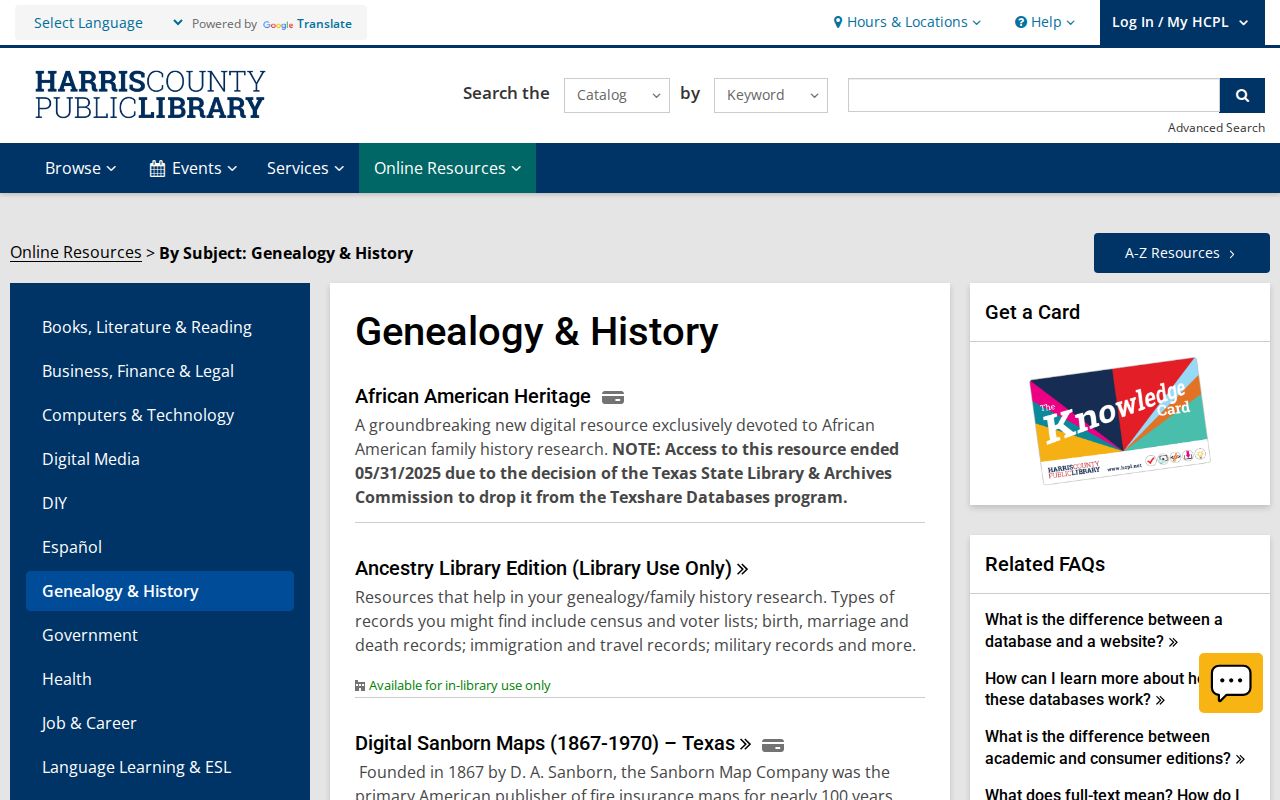
These HCPL resources can corroborate a dated Katy directory find with a census, local-history book, or newspaper item. Preserve the publication title, date, and page for each supporting result.
Katy users may need library-card authentication for remote databases, and Ancestry Library Edition is an on-site library-computer or Wi-Fi resource rather than unrestricted home access.
How Katy Directory Entries Read
A historical directory entry is compact and highly abbreviated. For a Katy directory entry, no digitized local example was verified, so the field inventory below comes from a 1910-11 Houston directory sample and teaches how to read the format, not how to identify a Katy household. Historical terminology in any volume needs to be read in its period context. Treat each entry as a dated lead that needs a source-specific follow-up.
| Name or business | Person, household, or business identity as printed in that issue. |
|---|---|
| Work description | Some entries give an activity or business description. |
| Residence notation | h. or r. can mark a home or residence; bds can indicate boarding or rooms. |
| Household context | Spouse or widow notation can appear, depending on the title and year. |
| Address and phone | Street address, phone abbreviation, office address, and advertisements can share the page. |
- Criss-cross directory
- A reverse section arranged by street or address, when the volume includes one. It is a dated address tool, not a current roll.
- Householder index
- An index focused on the principal named household entry. It may not name every person at an address.
- Abbreviation key
- The volume's guide to short forms such as residence or boarding marks. Photograph or transcribe it before interpreting entries.
A Katy reader should read the key before expanding a short form. A notation that appears to describe a household can instead identify an office, a rooming arrangement, or an advertisement placement within the volume.
Katy Directory Address Clues
For an old address, search both the name side and any reverse or criss-cross section that the issue supports. Street spellings, postal labels, county affiliation, and city boundaries can shift in ways a single entry will not explain. The city sits at the Harris, Fort Bend, and Waller junction, so a Katy mailing label is not enough to choose a records office. Use the printed address as one clue, then establish the county holding the Katy parcel and its legal description through the appropriate appraisal district.
A directory may show a public telephone or a business address beside a residence. It also may omit a household. The current address-by-address chain belongs with deed and appraisal research, while a past household trail can start from a dated directory. For a modern Katy parcel workflow, use the Katy street directory resource after identifying the historical address.
Note: A listing describes the issue date and its publisher's notation, not present occupancy or legal title.
Katy Directory Census Pairing
Use Katy directories to close the long spaces between federal census dates. The National Archives census guide explains that federal census releases follow a 72-year rule. The 1950 census became public in 2022, while 1960 is scheduled for release in 2032. Census material is historical household evidence, not a present-day resident record.
- Start with the directory issue nearest the question's year and copy the name, street form, and any household notation.
- Search the matching historical census using county and historical Katy place and enumeration context, not the modern boundary alone.
- Compare the household detail with a deed, newspaper, map, or archive citation before treating the address as the same place.
- Repeat in the next available directory issue, recording a move, spelling change, or absence without guessing why it occurred.
Federal schedules can include relationship, age, household composition, and geographic context, depending on the form. Katy directory entries supply the shorter year-by-year bridge. Together they build a better chronology than either record alone. Katy census research benefits from a directory issue on both sides of a census date.
Katy Historical Source Gaps
Several useful-looking sources remain unverified for Katy. No Katy-specific Sanborn fire-insurance map run was found in the official Library of Congress, TSLAC, or UT research leads, and a Houston Sanborn item is not a substitute. No dedicated full digitized directory for Katy has been confirmed. No local state-census index was identified either. Katy historical research should state these gaps in a citation rather than attaching coverage from a nearby city.
When a Katy directory trail stops, use the TSLAC county-record index, county archives, deeds, newspaper citations, and curator-mediated collections. A missing search result can reflect indexing, collection limits, geographic wording, or a true absence. Katy research should favor a documented gap over a nearby-city substitution. A missing result should not be expanded into a story about a household without another source.
Katy Heritage Collection Help
The Katy Heritage Society, established in 1979, preserves documents and objects distinctive of Katy and adjacent areas. Its Heritage Park at 5990 George Bush Drive and MKT Depot Museum at 5615 First Street offer local-history contacts for a date, place, object, photograph, or oral-history lead. Tours and access schedules change, so confirm them with the society before a visit. The society does not publish a searchable person-name catalog, so a focused holdings request is more appropriate than a request for a resident list.
Katy Heritage Society's preservation work provides a contact-based companion to Katy historical collections.

Use a directory issue, address, decade, or photograph description when contacting a local-history custodian. That detail helps staff locate a relevant object or file without implying that the collection is a public name index. A Katy historical lead can illuminate a period without assigning a person to a street. Keep the catalog description beside each request, and describe uncertainty in a timeline rather than filling a gap with a nearby community source.