
Katy Address History by Era
For Katy address history, previous residents of a Katy address leave different kinds of records in different eras. The appraisal roll is a tax record, not a title determination or an occupancy list. A county clerk index follows recorded instruments. Regional telephone directories, census schedules, archives, and newspapers can add a dated household layer. Start with the source whose date fits the question, and label each result with its custodian and coverage limit.
| Source | Years It Covers | Where Held | What It Shows |
|---|---|---|---|
| Harris County Clerk, Katy parcels | 1836 forward; pre-1961 indexing can require archive or microfilm work | Harris County Clerk | Recorded instrument trail and legal-description context |
| Fort Bend County Clerk, Katy parcels | Reaches into the 1820s by series | Fort Bend County Clerk OPR | Party, instrument, and document-type trail |
| Waller County deed microfilm, Katy parcels | Listed deed series include 1873-1888 | TSLAC county-record collection | Older deed and county-record fallback |
| Richmond Telephone Directory | Listed Katy-area issues 1918-2005, with gaps | UT Texas Directories collection | Regional telephone-directory context by issue |
| Federal census, Katy context | 1950 and earlier are public; 1960 is scheduled for 2032 | NARA and library databases | Historical household and geographic context |
| HCPL Katy Branch digital collection | Since 1921 | HCPL Digital Archive | Collection-level local documents and images |
A current address does not select a single records branch. Katy is a city at the Harris, Fort Bend, and Waller junction, and a Katy postal city can also reach outside the incorporated limits. Use the Katy parcel’s county and legal description before choosing a clerk index. The same rule keeps a historical address from being attached to the wrong county file.
Katy Address History Needs County
For a Katy parcel, begin by normalizing the street address and checking the county appraisal district that holds it. HCAD Quick Search, Fort Bend Central Appraisal District, and Waller CAD provide different paths to the account, situs address, tax-year detail, and legal description. Keep the mailing address separate from the situs address. Neither one alone identifies a current household.
Next, write down the account or property ID, subdivision or abstract, lot and block when shown, and the county. That information makes a Katy record trail more reliable than trying an old street form as the only key. It also explains why a past-residents search may move between county portals even when every record uses Katy as the mailing city.
Katy Previous Residents Through Deeds
For Katy deed research, a chain follows recorded ownership interests backward from a current parcel lead. It does not say who physically occupied a home during every period. The county index may organize documents by party, instrument number, date, document type, or legal description, so an address often needs to be translated into parcel terms first. Read the instrument image or obtain the clerk copy before relying on a name match.
- Use the correct Katy county appraisal roll to capture the current owner of record, situs address, account, and legal description.
- Search the county clerk’s real-property or OPR index for that Katy parcel owner as a grantee, or search by legal description or subdivision when the portal permits it.
- Record the instrument number, document type, recording date, legal description, and named grantor from the deed image or clerk record.
- Search that prior seller as a grantee to locate the earlier acquisition, then compare the legal description before moving backward again.
- When online coverage stops for a Katy parcel, use the clerk counter, a written copy request, microfilm, archive holdings, or a TSLAC depository.
- Grantor
- The party transferring an interest in the recorded instrument.
- Grantee
- The party receiving that interest. Searching a person in both roles can reveal different steps in a chain.
- Chain of title
- The sequence of recorded transfers or interests connected by the same legal parcel. It must be checked instrument by instrument.
- Legal description
- The lot, block, subdivision, abstract, or other formal parcel description. It is often more stable than an old street address.
Note: A Katy parcel owner, a deed grantee, a tax-mail recipient, and a household member can be different people in the same period.
Katy Past Owners in Harris
For a Harris County Katy parcel, the Harris County Clerk real-property portal describes land records from 1836 forward. The online record path is uneven. Katy historical research before 1961 can require archives, microfilm, or central-location assistance, while later online search and copy rules vary by year. The County Archives describes an electronic-index project begun in 2017 for older deed, mortgage, and contract material, which helps explain why a modern portal may not reveal every early step.
The Harris County Clerk real-property page is the starting point for a Harris Katy deed search.
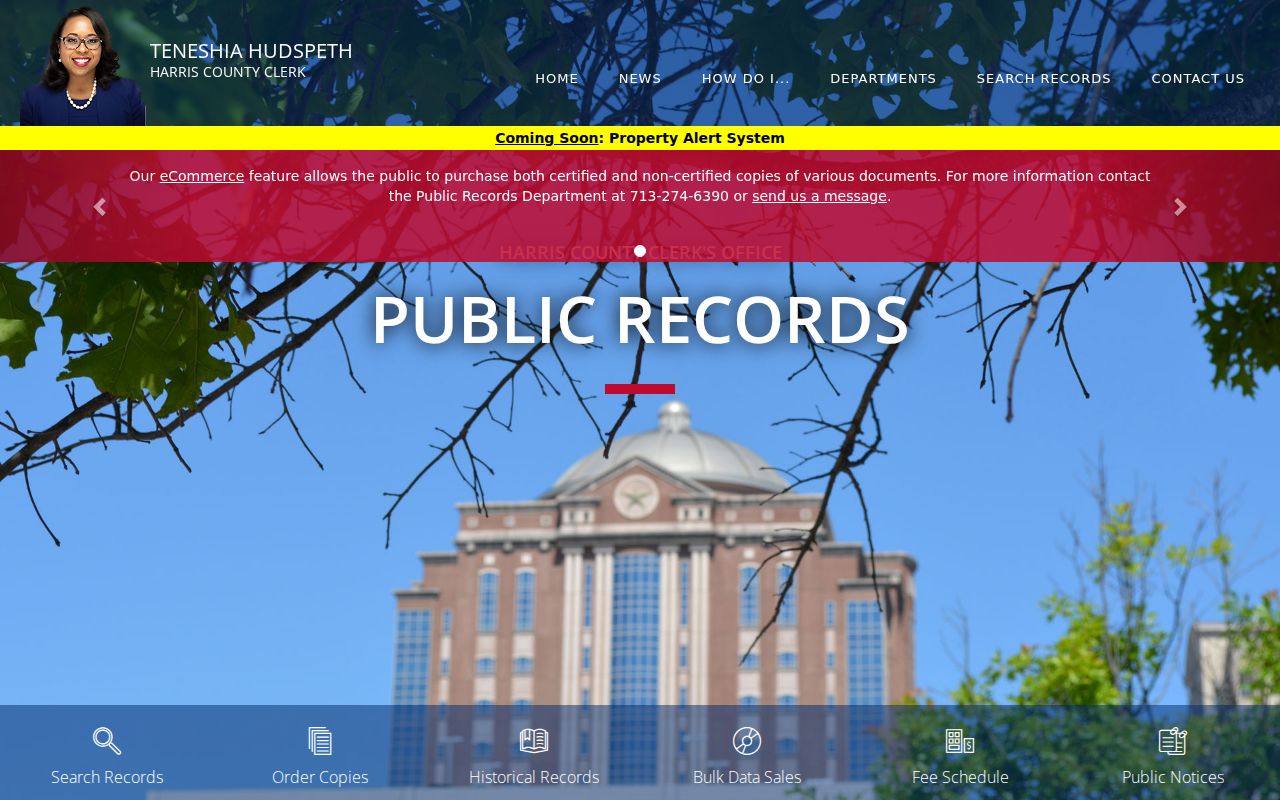
The portal image should be used with the Katy parcel’s legal description and an instrument trail. A result from HCAD is a useful entry point, but HCAD expressly does not determine title.
Katy Past Owners in Fort Bend
For a Fort Bend County Katy parcel, the Fort Bend County Clerk Official Public Records route includes deeds, mortgages, easements, liens, powers of attorney, assumed names, and related recorded material. The county describes an online historic library reaching into the 1820s by series. That phrasing matters because exact coverage differs by document type. For a Katy historical query, the index is not address-first, so begin with the FBCAD parcel and use the owner or legal description to form a party search.
Fort Bend’s OPR research route describes the party-name and document-search path for a Katy parcel.
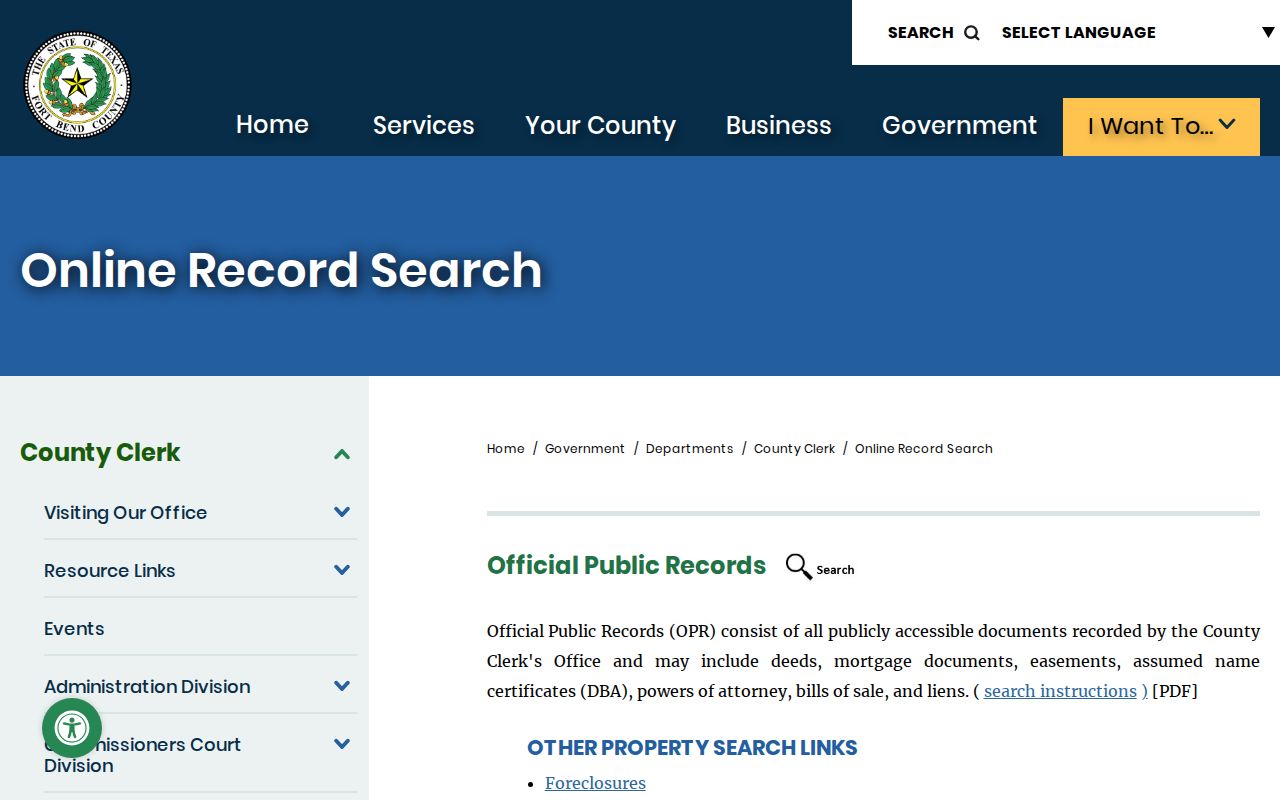
For Katy research requiring legal or historical certainty, inspect the clerk record or order a certified copy as appropriate. The county cautions that its online system is not the official repository and may not show unaltered contents.
Fort Bend’s Katy County Clerk branch is at 22333 Grand Corner Drive, Suite 104, with recorded-property and copy services available on weekdays. Confirm current Katy branch hours or copy procedures with the Clerk before a visit.
Katy Past Records in Waller
For a Waller County Katy parcel, the official-source review located Waller CAD but did not locate an exact County Clerk public-search URL. Do not treat the appraisal portal’s deed-history field as the deed image or assume it solves the missing clerk-index route. Use the CAD account, property ID, and legal description to prepare a county-clerk counter or copy request. The Texas State Library and Archives Commission supplies a documented fallback for older Waller series.
The TSLAC Waller County microfilm guide lists county-court civil minutes from 1876-1931 and transcribed deed or deed-record series with dates that vary by reel, including listed 1873-1888 deed records. For Katy history, the page is a series guide, not proof that every instrument is digitized or indexed online.
TSLAC’s city-directory research information is also useful when a dated Katy regional directory issue is part of the household trail.

Waller research for Katy parcels often needs a two-part citation: the appraisal lead that identifies the parcel and the archive or clerk source that confirms the historical instrument. Keep both records in the source chain.
Katy Previous Residents, Dated Households
Recorded transfers tell only part of the story. To learn who lived here before, pair a directory issue with a census year, newspaper item, archive file, or obituary source that matches the period. A Katy household trail needs that date match. The Richmond Telephone Directory is regional Katy-area coverage, not a dedicated Katy directory, and its listed issues extend from 1918 through 2005 with gaps. Census material must be labeled as historical household evidence. The 1950 census is public, while 1960 is scheduled for release in 2032.
- Choose the Katy target year and search the nearest available regional telephone-directory issue, noting its full title and date.
- Read any reverse or criss-cross section only when the issue includes one, and record the exact street spelling it uses.
- Pair the result with the county and historical Katy place and enumeration context in the closest public census schedule.
- Check a newspaper, public notice, archive file, probate record, or deed only as a dated corroborating source.
- Preserve conflicting entries instead of forcing them into a single household story.
The Katy historical collections themselves are detailed in the Katy city directory collections. HCPL also provides library-era tools for historical newspapers, HeritageQuest, and local-history searches. Its Digital Archive Katy Branch collection reaches back to 1921, but a collection search does not promise a name-level result.
HCPL Genealogy and History is a Katy library access channel for the dated household layer.

For a complete Katy citation, retain the directory issue, census date, publication title and page, and the custodian or database consulted. An obituary or notice can suggest a transition, but it should not replace a parcel or court record.
Katy Address History and Maps
Maps can help test an old street form, county line, or subdivision context. Katy’s official city map and CAD parcel viewers are useful geography tools, but they are not title surveys or household lists. No Katy-specific Sanborn fire-insurance map run was verified in the official research. A Houston Sanborn item is not a substitute for a Katy property footprint.
No authoritative citywide historic street-renumbering or renaming log was identified either. When a Katy address appears to change, compare deeds, plats, dated directory issues, maps, and city-held records. Do not declare a renumbering without a source that actually documents it.
Katy Previous Residents, Personal Research
For Katy family history, previous-residents research is best used for a house-history question, estate or heir work, local history, or checking a record trail. Keep the least identifying detail needed for that purpose. Texas public-record limits still apply to protected addresses, confidential voter fields, restricted court material, and other redacted information. A historical household record should never be used to reconstruct a protected location.
When a Katy public record appears wrong, take the correction question to the office that created or holds that record. Preserve the source date and record type, then ask the custodian about its correction or privacy route instead of copying the disputed detail into another search.
Lawful historical research. Use Katy historical sources for personal, lawful questions and source verification. Do not use a dated record to harass, track, or harm any living person, and do not try to defeat an address-confidentiality or redaction safeguard.